Empire Begins by Attacking Memory
Empire begins by attacking the nation’s memory. Pharaoh’s first move in Exodus 1 is not enslavement but forgetting. Three days after I preached it, the Times reported the plan for twelve warning signs outside the National Museum of American History. The sermon and the news, side by side.
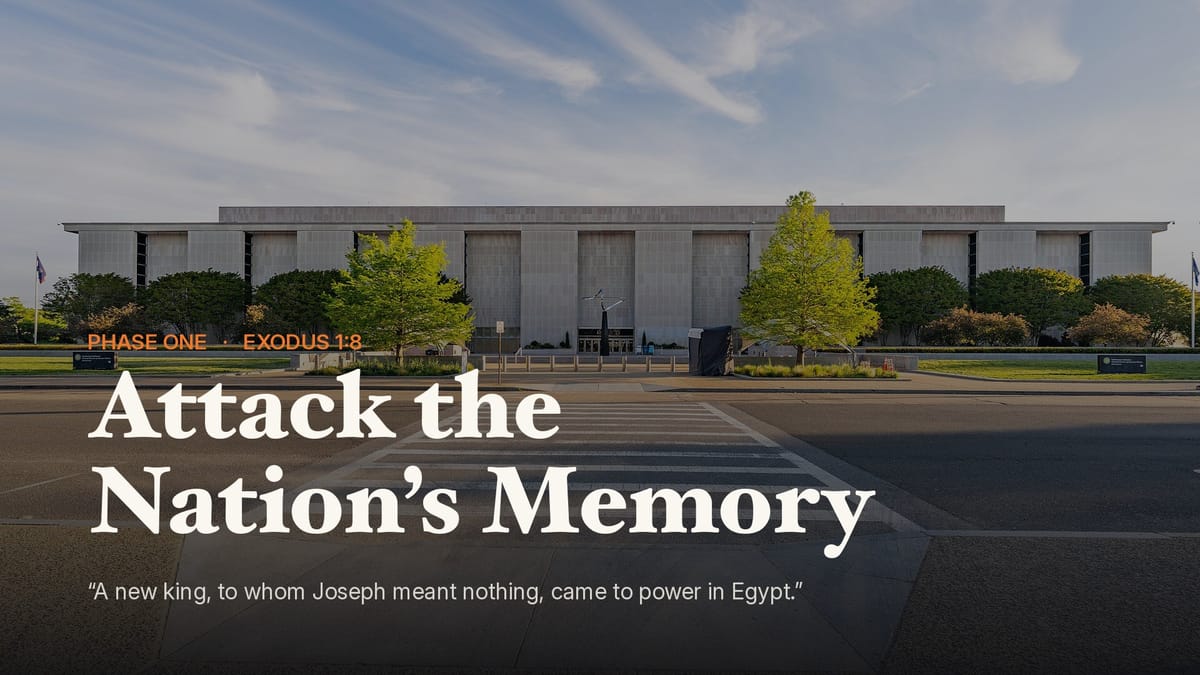
I had one of those strange moments this morning when the news seemed to catch up with Sunday’s sermon. On Sunday, as we opened our fall sermon series in Exodus 1, I called the first move in Pharaoh’s campaign against Joseph’s descendants “Attack the Nation’s Memory.” Pharaoh will eventually portray these people as a threat, exploit that fear, and enslave them, but it begins with a new king coming to power “to whom Joseph meant nothing.” My argument was that everything that follows depends on that act of forgetting. Joseph was the immigrant who had helped save Egypt during famine. If Egypt remembers that story, it becomes much harder to convince the nation that Joseph’s descendants are now its enemy.
As I said Sunday, “Empire always begins by attacking memory, because a people who remember that the stranger saved them cannot be taught to fear the stranger.” I even connected that point directly to what is happening at the Smithsonian.
Then this morning, three days after the sermon, The New York Times reported new details about the Trump administration’s plan to place twelve signs outside the National Museum of American History warning visitors about what the administration says is ideological bias in the museum’s presentation of American history. The plan itself predates Sunday, but what struck me was how closely the details reported this week followed the pattern we had just traced in Exodus.
Pharaoh’s first move is not enslavement. It is forgetting: “A new king, to whom Joseph meant nothing.” The struggle over memory matters because the stories a people remember shape the people they are capable of becoming. If Joseph is remembered as the immigrant who helped save Egypt, his descendants are neighbors with a history. If Joseph is forgotten, Pharaoh has much more room to teach the nation to see those same people as a threat.
That was the warning I was trying to name Sunday. Before Pharaoh changes laws, builds store cities, or institutionalizes oppression, he changes the story Egypt tells about itself. He refuses to remember Joseph and then teaches the nation to see Joseph’s descendants differently. In Exodus, forgetting is not incidental to what comes next. It makes what comes next possible.
Look at how closely the details track.
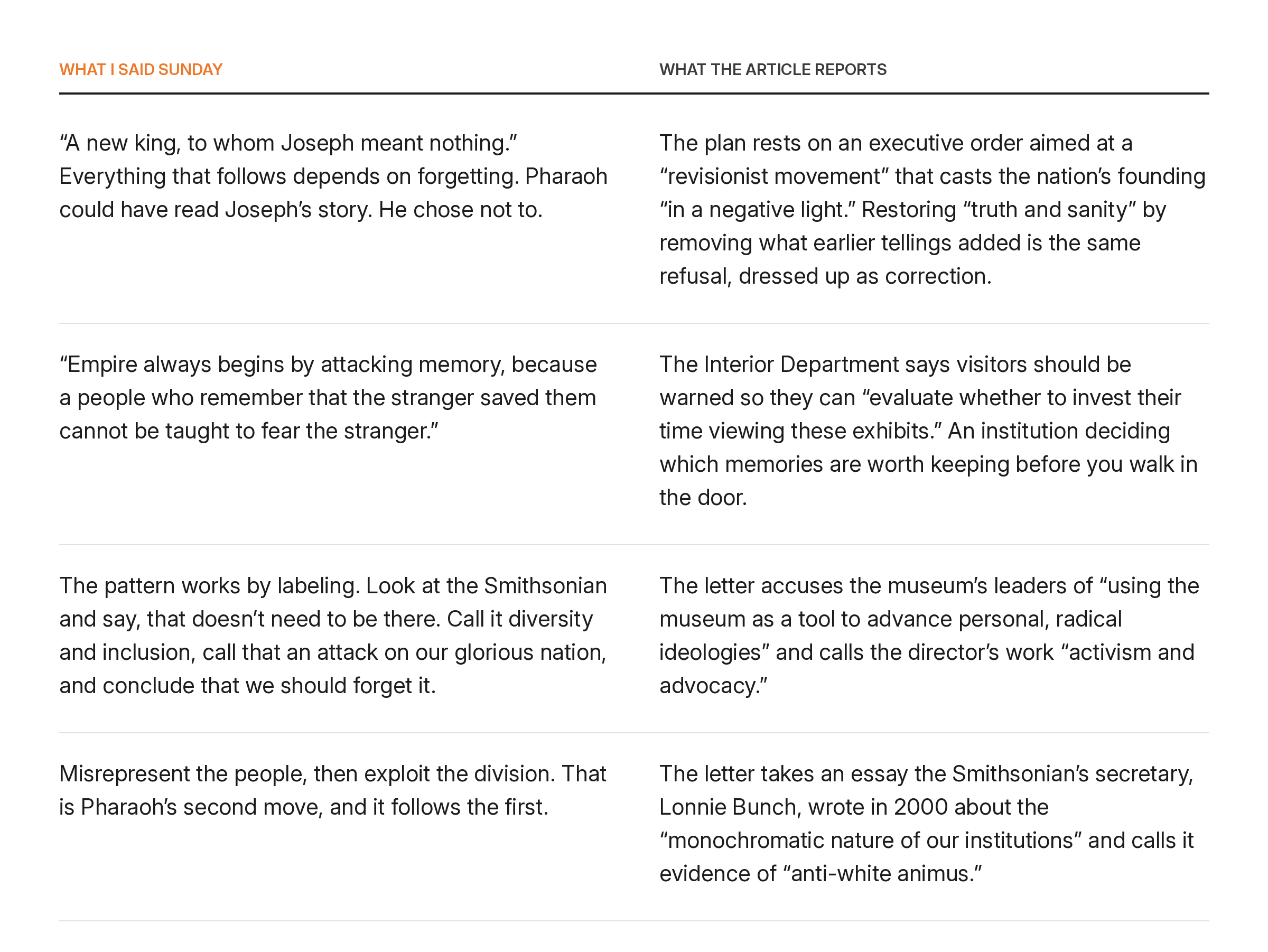
The museum’s director, Anthea Hartig, answered all of this in a congressional hearing this summer, and her answer is worth reading twice:
When historians talk about reframing a traditional narrative, we don’t mean erasing it. We mean adding the evidence, the voices, the objects that earlier tellings left out so that more Americans can see themselves reflected in the national story.
One side wants the story smaller so that certain people can be feared. The other wants it fuller so that more people can be found in it.
The church, by contrast, is called to be a people who remember. In Acts 7, Stephen reaches all the way back to this same story because remembering rightly can expose what fear wants us to forget. As I said Sunday, “The church that is born at Pentecost is a people trying to remember what Pharaoh worked so hard to forget.”
Maybe that is part of our work right now: to remember the whole story, including the people who saved us and the people whom the empire demands we forget. We should pay particular attention whenever someone tells us that our shared history would be better if parts of it simply disappeared.