This Is Not a Story Nobody Knew
For the second time this week, something I preached last Sunday showed up in the Times. Jefferson’s DNA now confirms what Sally Hemings’s descendants had been telling the nation for 150 years. Empire tries to force a nation to forget. Remembering means listening to the people it demanded we forget.
For the second time this week, something I preached about last Sunday has shown up in The New York Times.
Last Sunday, as we opened our Out of Egypt sermon series, I talked about the way Pharaoh’s empire depends on a nation forgetting its own history. A new king comes to power “to whom Joseph meant nothing.” As I said Sunday, “Empire always begins by attacking memory, because a people who remember that the stranger saved them cannot be taught to fear the stranger.”
Three days later, The New York Times reported new details about the Trump administration’s plans for the Smithsonian’s National Museum of American History. I wrote about that connection earlier this week.
But there was another part of Sunday’s sermon. I was talking about slavery in the United States and the ways we sometimes tell its history. Here is what I said Sunday, lightly edited from the transcript for readability:
God never ever had to be convinced that slavery was wrong. Let me just say that again, because I don’t know how you’ve inherited stories about slavery, especially in these United States. Chattel slavery was a perpetual state of enslavement. Thomas Jefferson, the third president of the United States, had a secret chamber off of his bedroom where he kept an enslaved girl. Her name was Sally Hemings. He fathered children with her, and he enslaved them. God never ever had to be convinced that slavery was wrong.
Five days later, The New York Times published another story, this time about new Smithsonian research involving Thomas Jefferson and Sally Hemings. Researchers sequenced Jefferson’s genome from strands of his hair and compared it with DNA from living Hemings and Jefferson family descendants. Richard Kurin, the Smithsonian scholar who led the project, described the findings as “extraordinary proof” that Jefferson fathered Hemings’s children.
And this is where the story takes me right back to Sunday: “Attack the Nation’s Memory.”
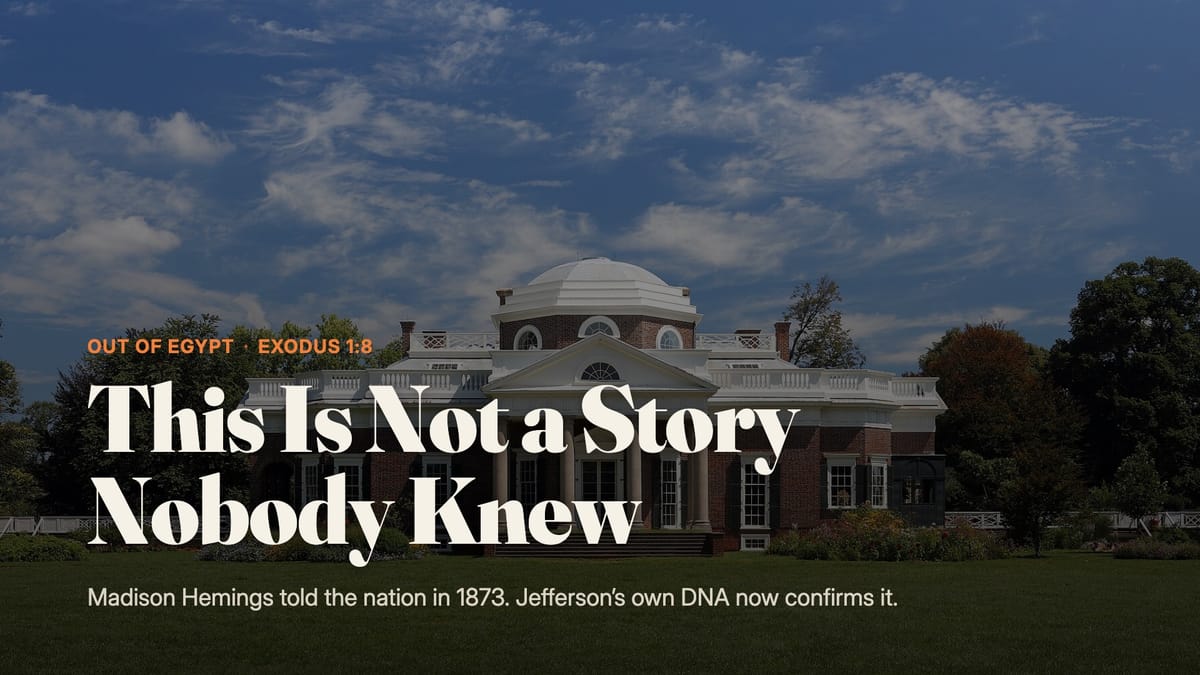
This is not a story nobody knew. Sally Hemings’s son Madison said in 1873 that Thomas Jefferson was his father. The Hemings family carried that history for generations. As the Times recounts, the claim was nevertheless discounted by much of the mainstream historical establishment well into the twentieth century. Now Jefferson’s own DNA adds another layer of evidence to what Hemings’s descendants had been telling the nation all along.
Empire tries to force the nation to forget.
That is what Pharaoh needed Egypt to do. Joseph had saved Egypt, so before Pharaoh could teach the Egyptians to fear Joseph’s descendants, the nation first had to forget Joseph. “A new king, to whom Joseph meant nothing.”
And sometimes remembering means listening again to the people whose stories the empire demanded we forget. It means telling the whole story, even when that story complicates the version of ourselves we would rather remember. This is why our history matters, why the stories of enslaved people matter, and why the church must be a community that remembers.
As I said Sunday, “The church that is born at Pentecost is a people trying to remember what Pharaoh worked so hard to forget.”