Signing a Different Future
When I signed Ann Arbor’s Comprehensive Land Use Plan 2050, I felt wonder more than anything else. This reflection explores housing, neighborhood character, exclusion, and why I believe cities are shaped by the choices we make and the future we dare to imagine.
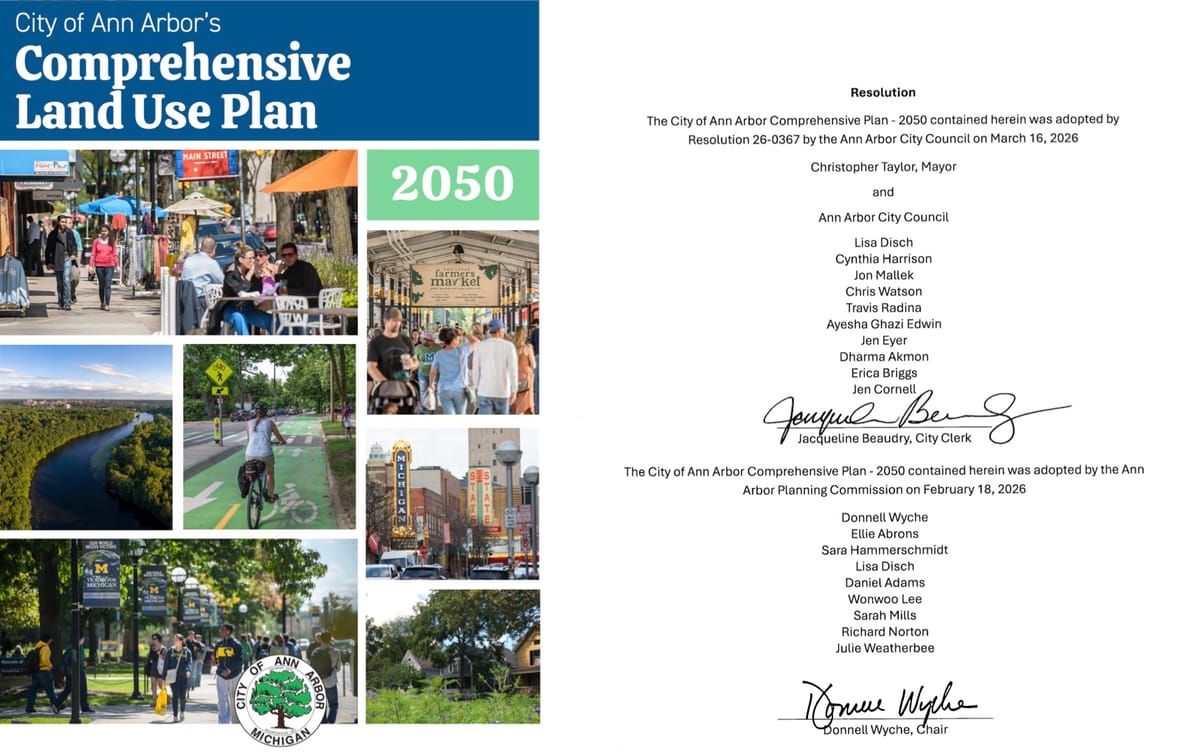
When I signed the capstone documents for Ann Arbor’s Comprehensive Land Use Plan 2050, my immediate reaction was simple: wow, this is really cool.
I do not mean that in a shallow way. I mean it in a deeply personal way. The younger version of me could never have imagined this moment. I do not think past Donnell would have looked 35 or 40 years into the future and said, "One day you will serve in a volunteer role on the planning commission for the fifth-largest city in the state of Michigan, and your voice will help shape what that city looks like for the next 25 years." So before I felt anything else, I felt wonder. I felt excitement. I felt the unlikely grace of being in that room, holding that responsibility, and participating in something that will outlast me.
That sense of wonder mattered because the work itself was not light. Plans like this can look technical from the outside. They involve land use categories, maps, public hearings, staff reports, policy language, and process. But underneath all of that are deeper questions about who a city is for, who gets to remain, who gets to arrive, and whether our values are real enough to shape the structures we live in.
One of the things I learned through this process is that Ann Arbor’s self-understanding and Ann Arbor’s lived political instincts are not always the same thing. This is a city that often sees itself as progressive, yet many of the concerns raised in opposition sounded far less progressive than the city’s self-image would suggest. That surprised me. I found myself struck again and again by the distance between people’s stated values and their realized values.
There was also a deep mistrust among some detractors of the process itself, including mistrust of its transparency. That was revealing. The irony, of course, is that this process unfolded in public. Our meetings were public. Our deliberations were public. Community members had repeated opportunities to address the commission. And we took those comments seriously as we deliberated and made our decisions. What I came to see more clearly is that transparency, while essential, is not always enough to overcome fear, suspicion, or resistance to change.
What surprised me most, though, was not disagreement itself. Disagreement is part of public life. What surprised me was how often the rhetoric of opposition felt demeaning and dehumanizing. Because I already live as a public figure, this process did not fundamentally alter my sense of what leadership requires emotionally or morally. As a pastor, I already know that public leadership demands patience, restraint, clarity, and a steady moral compass. But I was unprepared for how frequently I would hear my neighbors frame their concerns in ways that seemed, at least to me, to imply that people like me and families like mine do not really belong here.
I know many of those speakers would reject that interpretation. They would insist they were talking about policy, density, traffic, or neighborhood preservation. But anyone who has lived in America long enough knows that exclusion often speaks in code. It does not always announce itself directly. It is embedded in euphemisms, assumptions, and selective definitions of who a place is for.
That is why I became so wary of the phrase “neighborhood character” very early in the process. In principle, it sounds harmless, even admirable. In practice, in a racialized and economically stratified society, it can become a way of valuing bricks, wood, and buildings over people, and stability over inclusion. For me, neighborhood character is not fundamentally about preserving a particular arrangement of lots and structures. It is about preserving the possibility of being neighbors. It is about the widow next door who has become an adopted grandparent to our children. It is about the small acts of care that emerge over years of living alongside one another: sharing a slice of watermelon, checking in after a storm, noticing when someone needs help. It is about the relationships, obligations, and forms of care that make community real. That is what makes a neighborhood worth loving.
Too often, however, the rhetoric of neighborhood character becomes a way of saying that the existing built environment should be protected in such a way that certain other people never get to enter. Once you start listening carefully, you can hear the assumptions underneath. I remember one speaker essentially celebrating the fact that they had improved their home to the point that only someone with a certain level of wealth could purchase it. Statements like that reveal more than an economic preference. They reveal a social imagination about who counts as a desirable neighbor and who does not.
That is one reason my central hope for this plan is so clear. I hope it does what we set out for it to do: create more housing opportunity, and create housing opportunity at all income levels.
For too long, Ann Arbor has organized land use in a way that constrained housing rather than expanded it. We preserved large portions of the city in patterns that effectively reserved them for the most expensive forms of housing, and the result has been exclusion built into the structure of the city itself. When so much of a city’s residential land is dedicated to the costliest kind of housing, that is not a small technical detail. It is a profound policy signal about who gets access and who does not.
I see that clearly even in my own neighborhood. I live in Lansdowne. If you trace its history back to the era of the elementary school in the 1940s, you are looking at a neighborhood that has had generations to evolve. And yet here we are in 2026, with a proposed 75-unit development that may represent the first substantial new housing there in roughly 30 years. That fact alone says a great deal. When a neighborhood goes decades without adding housing, exclusion is not merely a byproduct. It becomes part of the pattern. So my hope for this plan is that it interrupts that pattern. I hope it creates room for more people, more kinds of households, and more diverse forms of housing because it now allows what had long been prohibited.
What I most want people to hear in this moment is something like prophetic imagination. I do not mean that as an attempt to impose religion on public life. I mean it as a way of naming my refusal to believe that the world as it is now is the world as it must remain. Too often we are told, this is just the way things are. This is just how cities work. This is just what the market produces. But there is a defeatism built into that story. It treats the present as permanent and mistakes inertia for inevitability.
From my own social location, and from the pastoral imagination that has shaped me, I do not believe that. I believe we are capable of imagining a more diverse, more inclusive, more populous, more vibrant, more hopeful, and more welcoming Ann Arbor and then working diligently toward its realization. That is what I hope this plan contributes to. Not a perfect future, and not a finished one, but a more open future than the one our old patterns allowed us to see.
That is why this moment matters to me. Not simply because I signed a document, but because this plan reflects a refusal to accept exclusion, scarcity, and stasis as inevitable. Cities are shaped by human choices. Which means they can be shaped differently. And that, to me, is where hope lives.