Phenomenal: College Tours, Formation, and Who We Become
Almost 40 years after I first got on a bus to visit colleges, I'm doing it again, this time alongside my daughter. So far, every school promises something phenomenal. What no one has said yet is the thing I most want to know: who will she become?
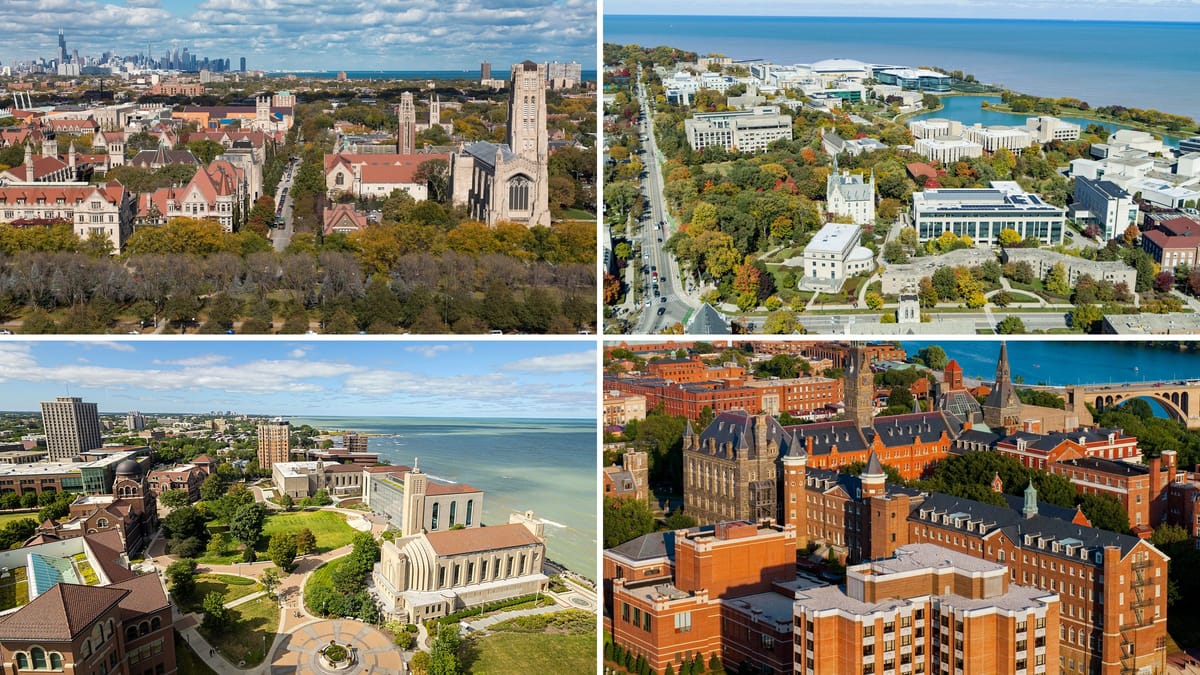
I’ve been thinking a lot about college lately because we’ve been traveling around the Midwest and East Coast visiting colleges with my daughter. What makes this experience particularly interesting for me is that I’ve done this before, although from a very different seat. When I was in middle and high school in Washington, D.C., I had the extraordinary benefit of being part of two scholarship programs. The first was the I Have a Dream Foundation, started by Eugene Lang in New York. My local sponsor was George F. Kettle, who owned the regional Century 21 real estate franchise and adopted a sixth-grade class at Winston Educational Center in Southeast Washington. I wasn’t part of the original class. I had to earn my spot when 13 openings became available.
Later, when I attended H.D. Woodson High School, I was part of the Futures 500 Club, a program sponsored by Fannie Mae that helped prepare and provide financial support for students to attend college. As part of those experiences, I saw a LOT of colleges. My recollection, which may be faulty at this late age, is that I visited somewhere north of 75 and probably fewer than 125 schools over about five years. Starting around eighth grade and continuing through my senior year, we would get on a bus and spend a week visiting colleges up and down the East Coast. We might see 10 or 12 schools on a trip, and we did these trips more than once a year. The funny thing is that as an eighth, ninth, tenth, eleventh grader, even as a senior, I really had no idea what I was looking for. Then I walked onto the campus of the College of Wooster and fell in love with it.
Going to Wooster remains one of the best decisions I’ve made in my life. It opened doors for me. It gave me opportunities. It taught me how to think critically, how to reason, how to synthesize information, and how to write. Almost 30 years after graduating, I can see just how important those things have been. I’m now in what I would describe as my third career, maybe my fourth. Actually, it probably depends on how we’re counting.
While I was still at Wooster, I became its first campus-wide information systems administrator, managing the college’s digital information, including its website, Gopher servers, and mail servers. I was sort of pioneering even then. After Wooster, I became a solutions architect at IBM and worked there for five years. I left IBM and became a pastor, and I’ve now been pastoring in the same place for almost 27 years. But even that doesn’t really describe the journey. During those years I taught web databases at the local community college. I became a community organizer and helped start the Coalition for Re-envisioning Our Safety here in Ann Arbor, working to seed an unarmed public-safety response in our city. I was appointed to the Ann Arbor City Planning Commission and am now in my second year as its chair.
Through all of that, I never really stopped developing software. I’ve continued creating websites and applications, and today I have about five applications in the marketplace earning money, something I hope will help me as I move toward my announced retirement from pastoring on August 31, 2030. So when I say that my college education prepared me for my life, I don’t mean that Wooster trained me for a particular job. It couldn’t have. Some of the jobs I eventually had, and certainly some of the technology I eventually worked with, didn’t even exist when I started college. What it gave me were tools that allowed me to keep learning, keep changing, keep creating, and keep finding my way into spaces I never imagined I would occupy.
Which brings me back to these college tours. Almost 40 years after I first started getting on buses to visit colleges, I’m doing it again, but this time I’m riding alongside my daughter. By the time we finish at the end of October, assuming all of our travel plans execute without failure, we will have visited 16 schools. And this time I’m listening differently. We’ve sat through presentations at the University of Chicago, Northwestern, Loyola, Georgetown, William & Mary, and others, and I’m struck by the product that colleges are offering us.
Your child is going to receive a world-class education. Your child is going to meet incredible people. Your child is going to have phenomenal internships and externships, phenomenal study-abroad opportunities, phenomenal research opportunities, and phenomenal networks. “Phenomenal” seems to be a particularly popular word on college campuses right now. And at the end of all of this, your child is going to be positioned to succeed. Basically: give us $70,000 to $105,000 a year, and we are going to give your kid an extraordinary education and help make sure that she has a job, or a place in graduate school, when this is all over.
And listen, those things matter. A LOT. We are talking about an enormous investment, and parents and students have every right to ask what they are getting for that investment. I’m extraordinarily grateful that my education gave me the tools to make a living and to navigate what has turned out to be a pretty unpredictable professional life. But after sitting through all of these presentations, I find myself noticing something that I’m not hearing very much about: Who might my daughter become because she spends four years with you?
Will she become a better person, a more compassionate person, a more loving person, a person more filled with wonder and curiosity and excitement about the world? Will she encounter people who challenge what she thinks she knows? Will she learn not only how to make an argument, but how to listen? Will she leave with a greater sense of responsibility for people beyond herself? Will she become more interested in the world and more committed to making some little corner of it better? Or will she simply become more successful?
I know that’s not a fair binary. Success and formation aren’t mutually exclusive, and maybe universities don’t see forming the whole person in quite that way as their job. Maybe I notice its absence because I’m a pastor. Who knows? But it has been interesting to me that, after sitting through presentation after presentation about everything these institutions can offer our daughter, nobody has really stood in front of us and said,
“One of the biggest things we hope happens during the four years your child spends with us is that she becomes a better human being.”
And maybe that’s too much to ask of a university.
As for my daughter, my goal in riding alongside her through all of this isn’t to steer her toward the place I would choose. I’ll admit that I really like the University of Chicago. I think it could be a fantastic school for her. It’s close, but far enough away. I love Hyde Park and the fact that the university is situated in a real neighborhood in a great American city, and I think she could have a phenomenal time there. See? Now they’ve got ME saying “phenomenal.” But this isn’t my decision, and our goal as her parents isn’t to push her toward where we want her to go or to try to live through some missed opportunity in our own lives.
Our job is to ride alongside her. I want her to choose a school that she is going to love. I want it to challenge her, and I want it to open doors for her that she doesn’t even know exist yet, just as Wooster did for me. But more than anything, I want her to find a place that will treat her well and cherish the gift that she is, not just to us, but to herself, to her friends, and to the world. Almost 40 years after I first started getting on those buses to visit colleges, maybe that’s the thing I understand differently now. The question isn’t only, “What will this education allow you to do?” It is also, “Who will you become while you’re there?”